| |||||
|
Many facets considered.
Is it FOMO? Real? Fundamental? Group Think?
| |||||
| |||||
| |||||
The twice-monthly read on the names shaping private markets, direct to your inbox.
| |||||
|
The Signal
Trend read
AI Infrastructure, Capital Waves, and the Comedy of Straight-Line ForecastsSystematic Intelligence · Featured brief
| |||||
| |||||
|
Transformative technologies do not move forward in a straight line. They advance in waves of optimism, capital formation, build-out, disappointment, adaptation, and renewed progress. The current AI cycle will fit that pattern. Capital is surging into chips, data centers, and frontier models, but the economic transformation will likely be slower, more uneven, and more expensive than the market's narratives and corporate returns imply. When markets need desperately to believe in something, they conspire with rosy forecasts. This matters because the opportunity is real, but the path is not linear. Every technology revolution begins as a software story, becomes an infrastructure story, and eventually turns into a discipline in distinguishing durable bottlenecks from well-funded enthusiasm. Markets typically prefer the version where progress arrives on schedule, margins remain immaculate, and every company claiming to be a platform becomes one. History, by contrast, has a recurring affection for delays, overruns, and selective survival. | |||||
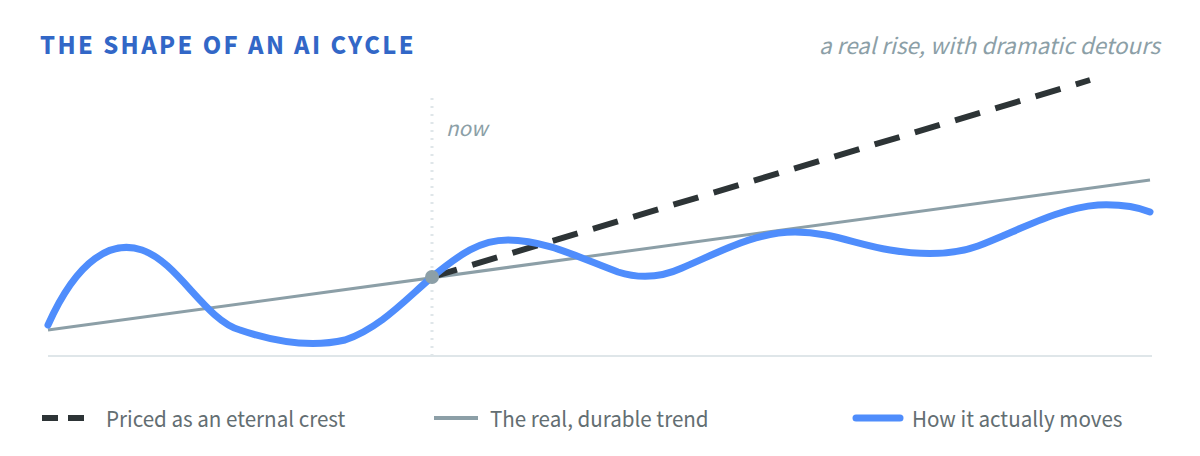
The shape of an AI cycle: a real, rising trend that the market swings around, versus the eternal climb it tends to extrapolate.
| |||||
|
The wave pattern The present AI build-out already has the economic shape of an infrastructure cycle. UNCTAD reported that announced foreign direct investment in data centers exceeded $270 billion in 2025, while data centers accounted for more than one fifth of global greenfield project values. McKinsey estimates that by 2030 companies may deploy $6.7 trillion into global data center infrastructure, including $5.2 trillion tied specifically to AI demand. That scale does not mean transformation arrives immediately. It means the market is pre-paying for capacity before demand, regulation, power availability, enterprise adoption, and workflow redesign have caught up. Markets are often directionally right but path-dependent wrong: they recognize a structural shift long before they can identify the eventual winners or the use cases that will matter most. The rapid emergence of agents and open-weight models is already a reminder that value rarely compounds exactly where early capital expects it to. In practical terms, this is the stage in which capital markets behave as though the future has already arrived, while operators are still looking for grid access, permitting, cooling, and customers willing to consume enough compute to justify the investment. One might call this the "instant future" phase: extraordinarily expensive, heavily marketed, and, for all its apparent sophistication, strangely dependent on substations. Where the money is going The money is flowing across three linked layers: chips, data centers, and LLMs. UNCTAD noted that the value of newly announced semiconductor projects rose 35% in 2025, underscoring that semiconductor capacity remains a strategic choke point in the AI stack. In the United States, announced semiconductor supply-chain investments have surpassed $645.3 billion since 2020, reflecting the fusion of industrial policy, strategic competition, and projected demand for AI compute. At the model layer, CB Insights reported that private AI funding exceeded $200 billion in 2025 and that LLM developers captured 41% of total investment. This is an important signal, but it should not be confused with where the most durable value necessarily sits. The applications and model providers create the demand signal; the infrastructure owners and bottleneck controllers frequently capture the economic leverage when scarcity emerges. The poets may write the future, but the landlords, grid operators, and chip suppliers often miss deadlines, face setbacks, have price spikes and over-invoice for it. This is with no factoring for chaos in energy markets, supply chain shocks and new protectionism sweeping the land. “History has a recurring affection for delays, overruns, and selective survival.”
Why the cycle resets Transformative technologies reset because the capital cycle runs ahead of the real adoption cycles. When markets extrapolate early usage curves too cleanly, they tend to fund both the winners and an impressive supporting cast of future case studies in overcapacity, margin compression, and strategic reconsideration. That does not invalidate the technology. It simply means that technological significance and investable timing are different questions, however inconvenient that may be for a pitch deck built around a five-year CAGR and a sunrise graphic. The reset mechanism is especially visible in infrastructure. UNCTAD reported that international infrastructure projects fell 10% in 2025 and that international project finance remained weak, even as capital concentrated in semiconductor and data-center projects. Capital does not flow evenly into all parts of the future at once; it bunches around the bottlenecks, starves the unfashionable but necessary layers, and periodically rediscovers that power, permitting, and physical construction do not read software timelines. | |||||
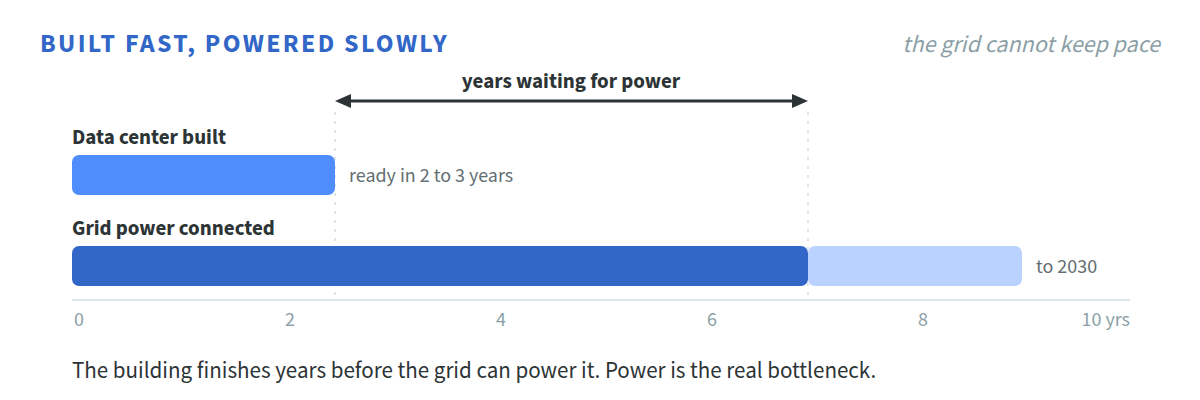
The build runs ahead of the grid: data centers finish in two to three years while grid connections take four to ten, with queues reaching 2030.
| |||||
|
Comparison with traditional infrastructure Traditional infrastructure is much larger in aggregate, but it is also slower, broader, and more politically mediated. One global outlook estimates $151.1 trillion of capital will be needed to build and maintain infrastructure over the coming decades, while the Global Infrastructure Outlook shows $79 trillion of current-trends investment versus $94 trillion needed, leaving a $15 trillion gap. Against that backdrop, AI infrastructure remains a smaller subset of global capex, even if it feels enormous within technology markets. The better way to see it is that AI increasingly behaves like a new infrastructure category. It is capital intensive, location sensitive, power hungry, and constrained by physical bottlenecks as much as by code quality. Unlike roads or water systems, however, it also reprices faster, obsolesces faster, and attracts a style of investor communication that can make a colocation lease sound like the moon landing. | |||||
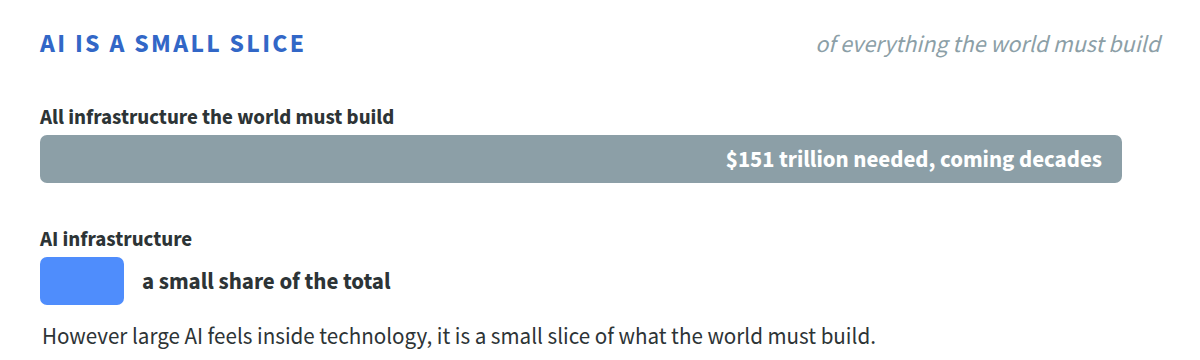
Keeping scale in perspective: AI infrastructure is a small share of the roughly $150 trillion of global infrastructure investment needed over the coming decades.
| |||||
|
“The poets write the future; the landlords, grid operators, and chip suppliers own the leverage.”
Investment implications The investment implication is to underwrite the wave itself. In the wave, duration is real, as are locations, setbacks and failures. The best opportunities often sit in scarce inputs, physical chokepoints, and businesses that can survive the resets between adoption waves. That favors semiconductors, data-center ecosystems, power-enablement assets, cooling, networking, and selected software layers that convert infrastructure intensity into durable customer dependence. Equally important, investors should be cautious about confusing demand creation with value capture. LLM developers and AI applications may define the narrative, and capital-intensive cycles often reward the players that own the bottleneck. The market has seen this movie before: the future does arrive, usually after several quarters in which the visible winners change, the cost of progress rises, and consensus quietly edits its old certainty into "long-term conviction." | |||||
|
Where We're Pointing Attention
| |||||
| |||||
|
The Honest Read · where the market really stands
| |||||
| |||||
|
The Mood
| |||||
| |||||
| |||||
|
The Systematic Signal
Twice-monthly private-markets intelligence. The Systematic Signal is market intelligence for professional recipients. It is not an offer, solicitation, or recommendation to buy or sell any security. Figures are drawn from cited third-party sources; details on unclosed rounds are reported, not confirmed. © 2026 Systematic Ventures, 110 East 25th Street, New York, NY 10010.
|
