| |||||||||||||||||||||||||||
|
Many facets considered.
Is it FOMO? Real? Fundamental? Group Think?
| |||||||||||||||||||||||||||
| |||||||||||||||||||||||||||
A twice-monthly, structural read on the names shaping private markets.
| |||||||||||||||||||||||||||
|
The Signal
Trend read
Higher, Longer: Rates, Inflation, and the Venture DietSystematic Intelligence · Featured brief
| |||||||||||||||||||||||||||
|
By the Numbers
| |||||||||||||||||||||||||||
| |||||||||||||||||||||||||||
|
Higher for longer is no longer a forecast. It is the ground we are standing on. Five percent Treasuries and stickier inflation are quietly repricing every venture book, and the question for allocators is where capital still compounds inside the new regime. History gives us a usable answer. The 1980s, revisited The closest usable U.S. comparison is the early 1980s: inflation had surged above 14% in 1980, rates rose sharply, recession followed, and the Federal Reserve chose to cure inflation with the monetary equivalent of a sledgehammer. Policy teams are different and new wisdoms offer real guidance, but low rates and no inflation will not define the next decade, and free money for the duration will not be wind at our back. We are stumbling into a new world order.
Venture was smaller then, less institutionalized, and decidedly less likely to describe a dog-walking app as “critical infrastructure.” Still, the historical return pattern is revealing. Early-1980s VC vintages generated positive nominal returns but generally failed to beat the public markets enough to compensate investors for a decade of illiquidity, capital calls, and quarterly letters explaining why the exit is “strategically delayed.” The verdict is not that venture failed. Early vintages in a higher-inflation, high-rate transition earned returns that were, how shall we put it, less “generational wealth,” more “respectable regional bank CD, with meetings.”
Later vintages improved as inflation fell, entry valuations reset, and the exit environment recovered. Of course, the economy was different, AI is genuinely new, and America sits in a different place internationally. | |||||||||||||||||||||||||||
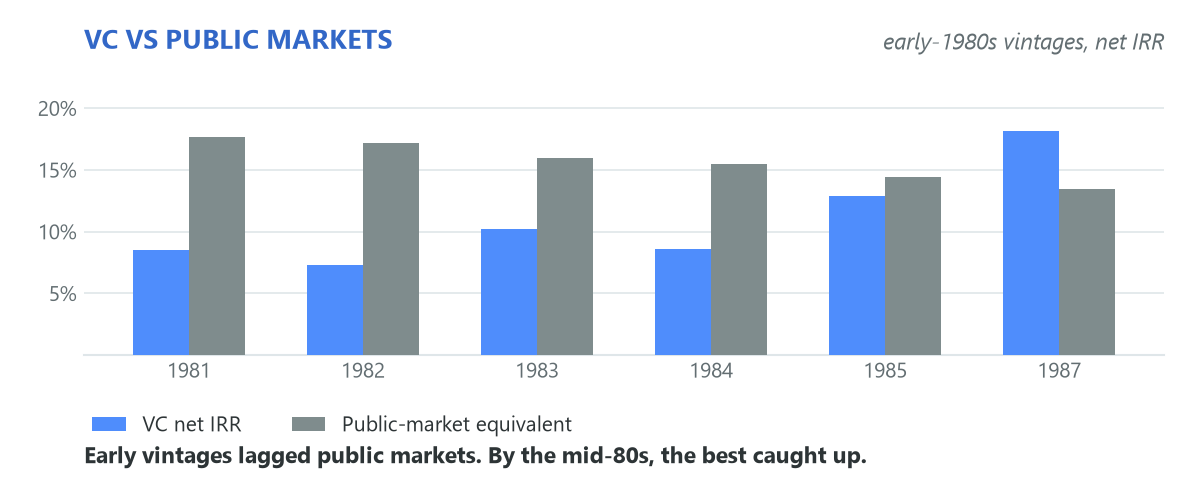
Early-1980s vintages: VC net IRR trailed the public-market equivalent early, then caught up by the mid-80s.
| |||||||||||||||||||||||||||
|
Duration gets a bill Inflation is irritating. Higher rates are expensive. Together, they are particularly rude to businesses whose economic payoff is scheduled for a distant and unspecified future. That is because venture’s favorite asset is time. A founder wants time to build product, recruit talent, acquire customers, burn cash, adjust the strategy, raise another round, and eventually explain that profitability is a social construct. In a zero-rate world, investors were happy to indulge the journey. In a 5% Treasury world, every extra year becomes an explicit cost. “A company expected to generate material cash flow in three years is inconveniently expensive. A company expected to generate material cash flow in ten years is a bond with worse documentation and a mascot.”
Higher discount rates punish distant cash flows more severely than near-term ones. That is why the damage typically appears first in long-duration public technology equities, then in late-stage venture valuations, then in the cheerful PowerPoint math supporting the next private round. In 2022, the rate shock hit late-stage venture especially hard as public comparables fell and IPO markets closed their doors with the enthusiasm of a Manhattan co-op board. | |||||||||||||||||||||||||||
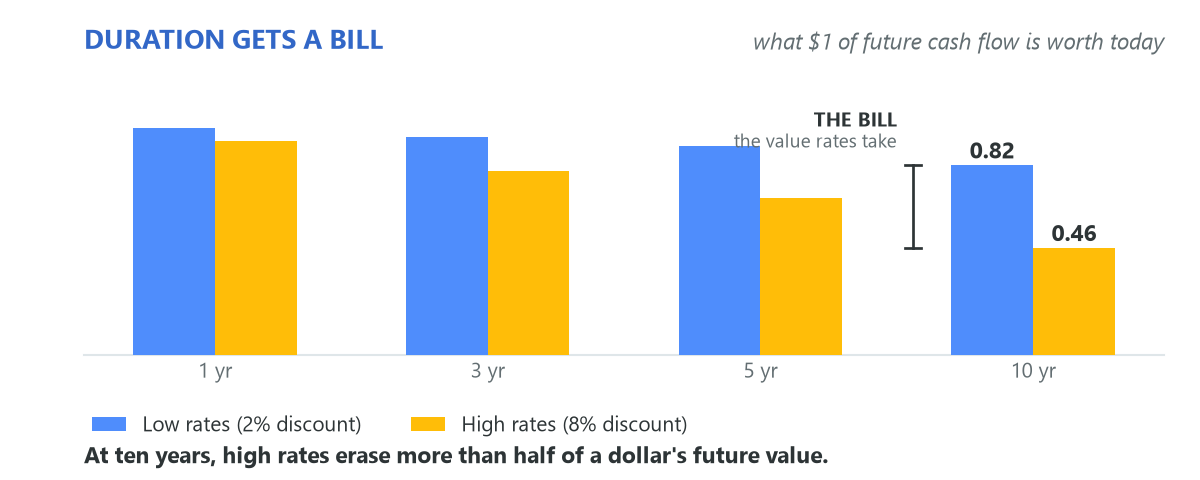
What one dollar of future cash flow is worth today at low versus high rates. At ten years, high rates erase more than half its value.
| |||||||||||||||||||||||||||
|
Not all venture suffers equally Forget software versus hardware. The category matters less than the shape of the business, and three questions decide how a company fares as rates rise:
Hardware is the obvious rate-sensitive suspect, it needs more money earlier, for tooling, production, inventory, and certification. But software does not automatically win. A mediocre SaaS company with 120% net revenue retention only in a spreadsheet is more exposed than a robotics company with a defense contract, a hard technical moat, and a customer who is not going anywhere. You do not switch a mission-critical vendor on a Friday afternoon.
Fintech versus cyber Fintech is often a disguised macro trade. If the model depends on consumer borrowing, merchant volumes, low-cost warehouse funding, rapid credit expansion, or a capital-markets window remaining open, inflation and higher rates can hit it from several directions at once. The borrower gets weaker, the cost of capital rises, and the valuation multiple heads south, all before lunch. Cybersecurity, by contrast, sells insurance against catastrophe. Some software you can postpone. A breach you cannot.
A CFO can defer a nice-to-have. A security upgrade after a ransomware incident is harder to defer, because the board, regulators, customers, and insurers all develop very strong opinions. It is not immune, tool sprawl and long sales cycles are real, but in a selective spending environment, cyber has a better claim than most to must-have status. | |||||||||||||||||||||||||||
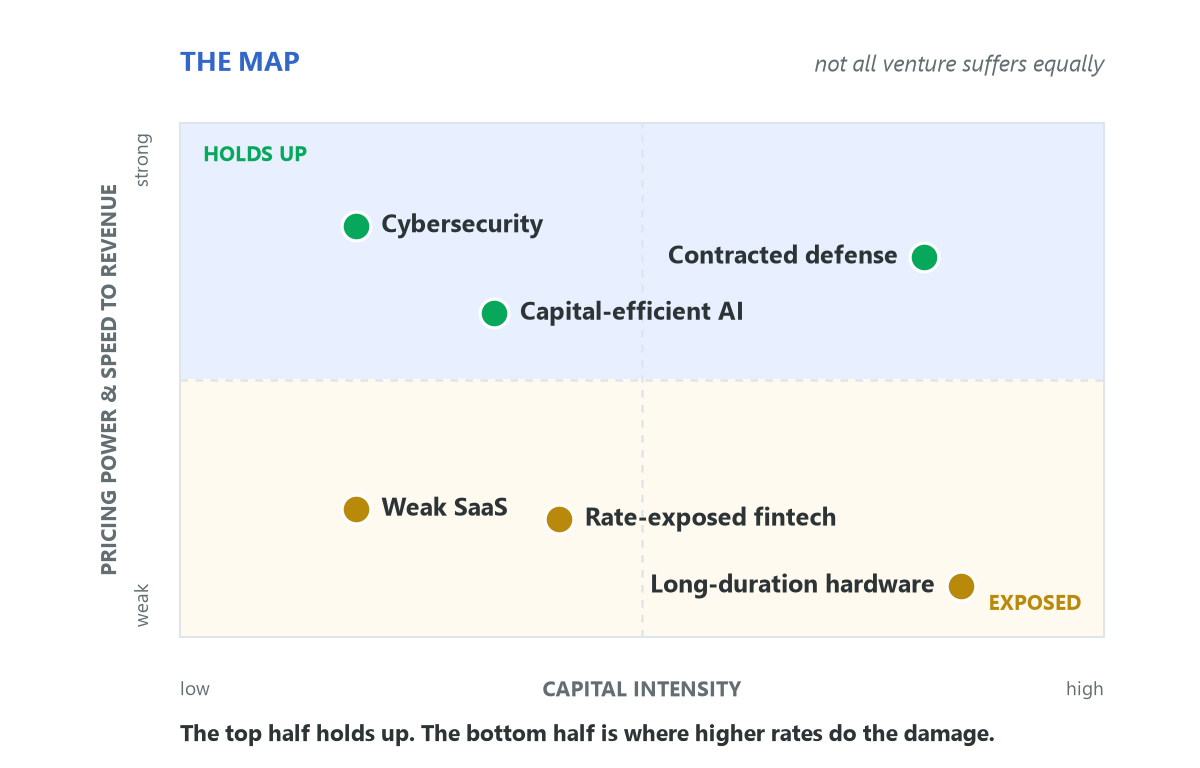
Venture sectors by capital intensity and pricing power. The top half holds up; the bottom half is where higher rates do the damage.
| |||||||||||||||||||||||||||
|
The Honest Read · who the regime helps and hurts
| |||||||||||||||||||||||||||
| |||||||||||||||||||||||||||
|
The Sector Scorecard · how each corner of venture holds up
| |||||||||||||||||||||||||||
| |||||||||||||||||||||||||||
|
The new venture diet The next five years may reward a less glamorous form of venture discipline: › Fund the company that can reach a hard technical or commercial milestone with a finite amount of capital. › Prefer contracted revenue, strong retention, gross-margin expansion, and pricing power over a heroic total-addressable-market slide. › Underwrite follow-on rounds as uncertain, not inevitable. › Treat time to meaningful cash flow as a valuation variable, not an operating footnote. › Save the largest multiples for businesses that can plausibly become scarce strategic assets. The best venture vintages often emerge from adversity, but not because adversity is charming. They emerge because fewer investors overpay, fewer companies survive on narrative alone, and capital goes to businesses that can demonstrate something increasingly radical: customers who pay, economics that improve, and a future that does not require a friendly Fed chair.
| |||||||||||||||||||||||||||
| |||||||||||||||||||||||||||
|
The Systematic Signal
Twice-monthly private-markets intelligence. The Systematic Signal is market intelligence for professional recipients. It is not an offer, solicitation, or recommendation to buy or sell any security. Figures are drawn from cited third-party sources; details on unclosed rounds are reported, not confirmed. © 2026 Systematic Ventures, 110 East 25th Street, New York, NY 10010.
| |||||||||||||||||||||||||||
|
